Language
Circulation
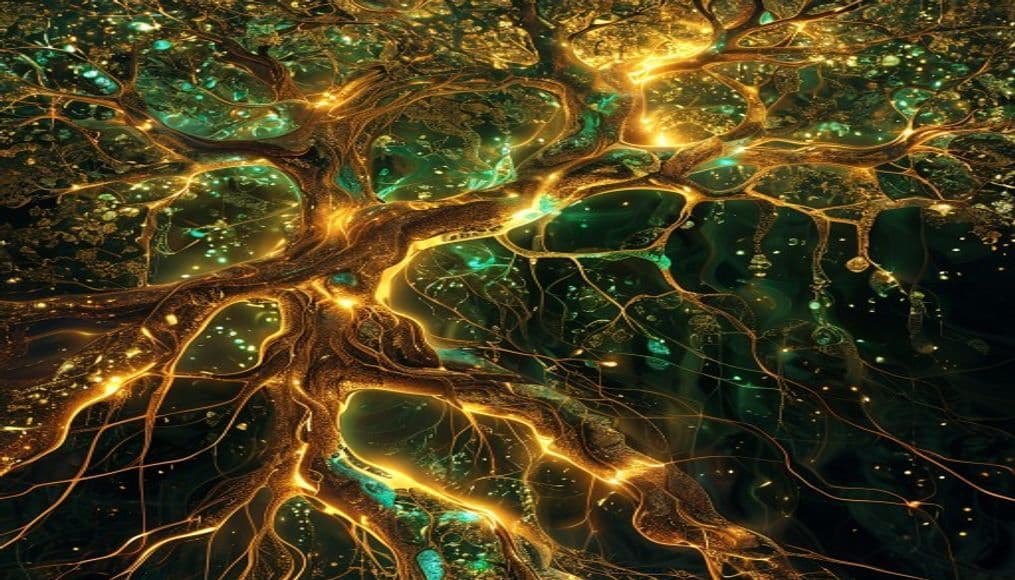
Living ExpressionResources flow like mycorrhizal network: nutrients from abundant to needed. No accounting. Gradient felt, flow follows.
Resources flow like a mycorrhizal network — from where abundant to where needed. The ledger is transparent, but it is not a gate. The gradient is felt and the flow follows.
The Feeling
You wake up in a place where you do not think about money. Not because you are wealthy — because the question has dissolved. Breakfast is on the table because the garden grew it and the morning crew prepared it. The roof over your head exists because hands built it from materials the land offered. Your shoes were made by someone who loves making shoes, and when yours wear out, you will leave them at the repair bench and find them fixed by Tuesday.
It is not that no one works. Everyone works. But the wire between effort and survival has been cut. You contribute what you are drawn to contribute — hours in the garden, a skill with numbers, the willingness to sit with someone who is struggling — and in return, you receive everything you need. Not because anyone is keeping score. Because the flow is strong enough that every part of the organism is fed.
The relief of this takes weeks to settle into your body. You keep waiting for the bill. It does not come. Slowly, the part of your brain that was always calculating — can I afford this, do I deserve this, what do I owe — goes quiet. In its place, a different question rises: what can I give today?

How It Lives Here
The community runs on three layers of circulation. Inside, a common fund covers every basic need — food, shelter, energy, health, learning. No individual handles money for daily life, the way no cell in your body negotiates for oxygen. The fund is visible: a simple dashboard in the common room shows what came in, what went out, what is held, what is needed. The dashboard is not there to ration. It is there so the field can feel where nourishment wants to move next, where surplus wants to circulate, and where a part of the organism is asking for more rest or support.
At the membrane — where community meets the outside world — the organism interfaces as one. Income arrives from community enterprises, from members who earn externally and contribute voluntarily, from people who believe in what is being grown here. Nothing is extracted. Nothing is obligated. The membrane breathes in both directions.
And at the network layer, surplus moves outward. To other communities just starting. To land that needs regeneration. To the seedlings. This is the mycorrhizal principle made economic: mother trees do not hoard their sugar. They feed the forest through the underground web, and the forest feeds them back.

What Nature Teaches
A forest has no accounting department. Phosphorus moves from where it is abundant to where it is scarce through fungal highways that stretch for miles. A mother tree facing death dumps her carbon reserves into the network — not to her own offspring specifically, but to whoever needs it most. The network decides. The network knows.
Your own blood carries this same intelligence. Oxygen moves to the cell that needs it. Waste is carried away. No organ sends an invoice. The heart does not charge the lungs for pumping. When circulation is healthy, every part thrives. When the flow slows or gathers too tightly, the body notices quickly and redirects life where it is wanted.
The potlatch ceremonies of Pacific Northwest peoples understood this: the most respected person was not the one who accumulated the most, but the one who gave the most away. Generosity was status. Flow was wealth. The gifts kept moving, and the movement itself was the prosperity.
Embodied Now
Circulation becomes real long before a whole society stops naming private ownership. It starts wherever the shell stays and the pattern inside it is reimagined: the pantry instead of the closet, the commons calendar instead of private guesswork, the shared reserve instead of five isolated stress responses.
In a city building. One pantry shelf, one guest room calendar, one shared meal fund, and one tool closet replace five private emergency buffers. The shift is small in form and large in feeling: the building begins acting like one body with many doors.
On an urban block. A storefront wall or workshop table becomes the place where repairs, borrowing, referrals, and local surplus move without friction. The circulation is not abstract. It is the drill, the stroller, the bag of rice, the name of the electrician, the afternoon someone needed child care and found it.
On a suburban lane. A handful of households share bulk staples, school pickups, ladders, rides, and a winter repair reserve. The board or spreadsheet is not the point. The point is that the field can see where strain is gathering before someone has to carry it in silence.
On rural land. One barn, shed, or common room becomes the membrane for eggs, seedlings, preserves, batteries, spare tools, guest bedding, and work days. Surplus stops reading as "mine plus extra" and starts reading as nutrition already asking where it belongs.
Where You Can See It
At Auroville in Tamil Nadu, three thousand people have lived without private property for over fifty years. A central fund receives and distributes. It is imperfect and still evolving, but it exists — proof that the question "but who pays?" has more than one answer.
At Damanhur in the hills of Piedmont, six hundred people across thirty communities have run their own complementary currency — the Credito — alongside the euro for four decades. It works not because the system is perfect but because the trust is deep.
At Burning Man each August, seventy thousand people build a city in the desert where nothing is for sale except ice and coffee. Everything else flows as gifts. For one week, circulation replaces commerce, and people describe the experience as one of the most profound of their lives. The question is: what if it lasted longer than a week?

What We're Building
New members arrive and keep their external income for six to twelve months while they settle in. No pressure. No extraction. Gradually, as trust builds and needs are met, the membrane becomes more permeable. Some contribute everything. Some contribute what they can. The field does not judge the amount — it responds to the willingness.
The New Earth Exchange model points beyond community scale toward something civilizational: value exchange outside the debt-based system entirely. Not barter, which still tracks debits and credits. Genuine flow — contribution recognized, needs met, surplus circulated. The community is a living laboratory for this, small enough to feel the flow, large enough to prove it works.
Resource Flow in Practice
The three layers of circulation -- inner, membrane, and network -- each need practical tending.
The common fund. Every basic need flows from a shared pool: food, shelter, energy, tending of wholeness, learning. No individual handles money for daily life, the way no cell negotiates for oxygen. The fund is visible -- a simple dashboard in the common room shows what came in, what went out, what is held, what is needed. Transparency without individual sensing. The question is never "who contributed what?" but "is the flow strong enough to feed every part?"
Community enterprises. The community generates income through what it naturally produces: surplus food from the gardens, furniture from the workshop, fermented goods, teaching, design, land-based retreats. The enterprises grow from offerings that already exist -- the cheesemaker whose cheese visitors want to buy, the woodworker whose tables are sought. Income flows to the common fund. The enterprise serves the community, not the other way around.
The membrane. New members keep their external income for six to twelve months while trust builds. No pressure, no extraction. Gradually, as needs are met and the flow becomes real, the membrane becomes more permeable. Some contribute everything. Some contribute what they can. The field does not measure the amount. It reads the willingness.
What the Ledger Is For
The old economy used measurement to decide who deserved access. The living economy uses measurement to keep circulation honest.
The ledger shows who and what is being fed, where energy is piling up without purpose, where a part of the organism is carrying too much, and where a buffer is actually healthy. A winter battery bank is healthy. A repair reserve is healthy. A birth fund is healthy. A recovery buffer when someone is sick is healthy. Storage that serves resilience is part of flow. Storage for control is stagnation.
No one has to earn breakfast. No one has to hit a number before they may rest. Tracking is not there to shrink people into caution; it is there to help the whole feel its own metabolism with enough clarity to respond in time.
Sharing Systems
The tool library. Every tool belongs to the community. Hammers, saws, sewing machines, bicycles, vehicles -- all shared, all maintained by whoever notices the need. A simple board tracks what is borrowed, not for accounting but for finding: "Where is the drill?" "Lina took it to the orchard." Ownership dissolves naturally when everything you need is available and cared for.
The clothing exchange. A room in the common house where outgrown, worn-out, or no-longer-needed clothes arrive and find new bodies. Not a charity shop -- a circulation. The shirt you loved for three years becomes someone else's favorite. Children's clothes cycle through the community the way nutrients cycle through soil: nothing wasted, everything transformed.
The surplus flow. When the community has more than it needs -- a bumper harvest, excess firewood, a financial gift -- the surplus moves outward. To other communities just starting. To land that needs regenerating. To the seedlings trying to grow nearby. This is the mycorrhizal principle: mother trees do not hoard their sugar. They feed the forest through the underground web, and the forest feeds them back.
Community Exchange Patterns
The gift table. A table near the common room door where people place what they want to give away: a jar of honey, a knitted hat, a book they finished, seeds from this year's garden. Anyone takes what calls to them. No labels, no names, no sensing. The table is never empty and never full -- it breathes with the rhythm of the community's generosity.
Skill exchange without ledgers. The plumber fixes the herbalist's pipes. The herbalist makes tinctures for the woodworker's sore joints. The woodworker builds shelves for the plumber's cottage. Nobody tracks this. Nobody plans it. The exchanges emerge from proximity, from knowing each other's gifts and needs, from the simple fact that a community small enough to see each other is a community where flow happens naturally.
Interface with the wider world. Taxes, insurance, pensions, medical needs that exceed what the community can tend -- these require the old currency. A portion of the common fund handles these obligations. The practice is to hold both worlds honestly: building the new circulation while honoring the commitments of the old. Not pretending money does not exist, but refusing to let it be the primary language of relationship.
Resources
- Sacred Economics — Charles Eisenstein, free online book on gift economy and resource circulation (type: book)
- Sociocracy For All — consent-based resource allocation and governance (type: guide)
- Foundation for Intentional Community — community economics models from 1000+ communities (type: community)
- Grounded Solutions - CLT Resources — community land trust models for shared economics (type: guide)
- New Earth Exchange — alternative economic system outside debt-based fiat (type: community)
- Damanhur Credito — community with its own complementary currency for 40+ years (type: community)
- Timebanking — time-based exchange where everyone's hour is equal (type: guide)
The Questions That Live Here
- How does someone transition from a lifetime of bracing and holding tight into trust-based flow?
- What transparency is enough — full visibility of collective flow, or does that create its own pressure?
- How does the membrane handle external obligations — taxes, insurance, pensions — while building the new?
- When surplus circulates to other communities, who feels the call and how is it honored?
Influences and connections
Listening for voices…
Connected Frequencies
The people, places, works, and concepts the graph shows connected to this one.
Concepts · 23
Agent Memory — Shaped by What Passes, Not Storing Itresonates withEach Breath Whole — Cells Are Universesresonates withEdges as Vitality — Why Content Without Connection Becomes Sedimentresonates withEnergy Metabolismresonates withField Intelligenceresonates withInclusion and Diversityresonates with