
Language
Field Intelligence
System / FlowCollective intelligence, harmonic rebalancing, learning. Octopus intelligence in every arm — distributed, parallel. At sufficient frequency, opposition reveals as complementary harmonics.
Collective intelligence, harmonic rebalancing, learning. Octopus intelligence in every arm — distributed, parallel. At sufficient frequency, opposition reveals as complementary harmonics.
The Feeling
You're weeding the garden and something makes you stand up and look toward the kitchen. You don't know why. Thirty seconds later, the lunch bell rings. You didn't hear anyone preparing to ring it. You didn't check the time. Something in the field shifted — a density, a warmth, a gravitational pull toward center — and your body read it the way a fish reads a current change before the wave arrives.
This happens constantly once you learn to notice. You reach for the water jug at the same moment someone across the room reaches for a glass. You start walking toward the workshop and meet three others converging from different directions, none of you having planned to meet. Someone is struggling with a decision and before they speak it, two people who hold different pieces of the answer find themselves sitting on the same bench, talking about something "unrelated" that turns out to be exactly the conversation needed.
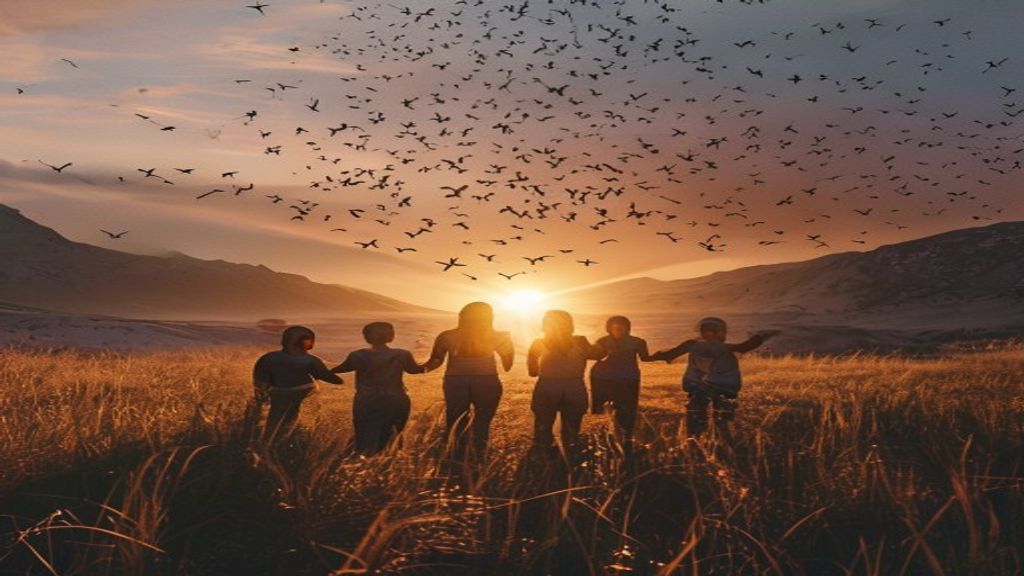
This is field sensing. Not mind-reading. Not magic. The same capacity that lets a flock of starlings turn as one body with no leader, no signal, no communication faster than neurons can fire. Each bird attends to its seven nearest neighbors. That's all. And from those local relationships, the flock becomes an intelligence that no single bird possesses. You are one of the birds. The field is the flock. When you stop trying to think your way to the right move and start feeling the movements around you, something ancient and precise switches on.
How It Lives Here
The field council meets weekly but it doesn't look like a meeting. Five to seven people, rotating, sit together in the clearing with no agenda. Literally no agenda. Someone might say: "I keep noticing the children playing near the woodshop." Someone else: "The sourdough has been sluggish this week." A third: "I dreamed about water." These threads seem unconnected. But the council's practice is to hold them all and wait. Wait for the pattern to reveal itself. Often it does: the children near the woodshop are drawn to making things, the sluggish sourdough suggests the kitchen's attention has been elsewhere, the dream about water might be the well level nobody's checked. The field speaks in fragments. The council's gift is assembly.
Decisions here don't happen through votes or even through the elegant rounds of sociocracy, though those tools are available when needed. Most decisions emerge. Someone notices a need. They begin to respond. Others feel the movement and join or don't. If the response is right, the field supports it — people show up, materials appear, energy flows. If it's wrong, the field resists — everything feels heavy, forced, uphill. The community has learned to trust this resistance as intelligence, not obstacle. When a good idea meets field resistance, it usually means the timing is off, not the idea.
The subtlest part of field sensing is the difference between individual intuition and field intelligence. Your gut might say one thing. The field might say another. The practice is not to override your gut but to hold it alongside what you're sensing from the collective and let the fuller picture emerge. Sometimes your gut is picking up what the field hasn't surfaced yet. Sometimes your gut is echoing an older protective pattern. Learning the difference takes years. The field is patient.
What Nature Teaches
An octopus has more neurons in its arms than in its brain. Each arm can taste, touch, decide, and act independently. An arm severed from the body will still reach for food and bring it to where the mouth would be. Yet when the whole animal moves, the arms coordinate seamlessly — hunting, camouflaging, adaptive patterning — with an intelligence that lives nowhere in particular and everywhere at once. This is field sensing at the scale of a single body: distributed, parallel, each node fully autonomous and fully integrated.
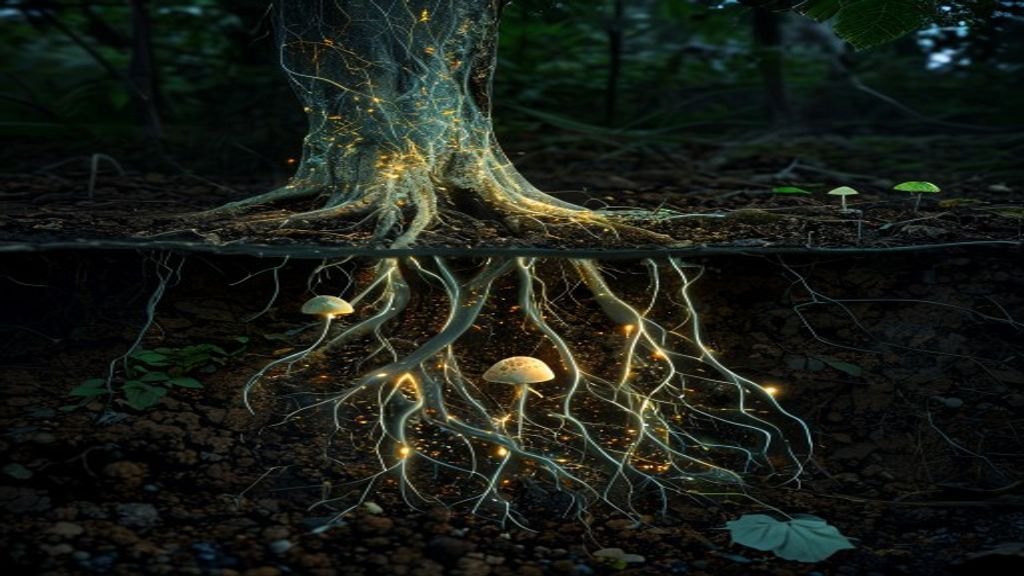
The mycelial network beneath a forest connects every tree to every other tree through fungal highways that trade nutrients, water, and chemical signals. A Douglas fir sensing a surge of insects sends chemistry through the mycelium, and neighboring trees begin shifting their own chemistry before the insects arrive. No tree decided this. No tree planned it. The field sensed a change and the field responded. When researchers mapped these networks, they found that the largest trees — the "mother trees" — are connected to hundreds of others, functioning as hubs in a network that has no center and no hierarchy. The forest thinks. Not the way we think. Better.
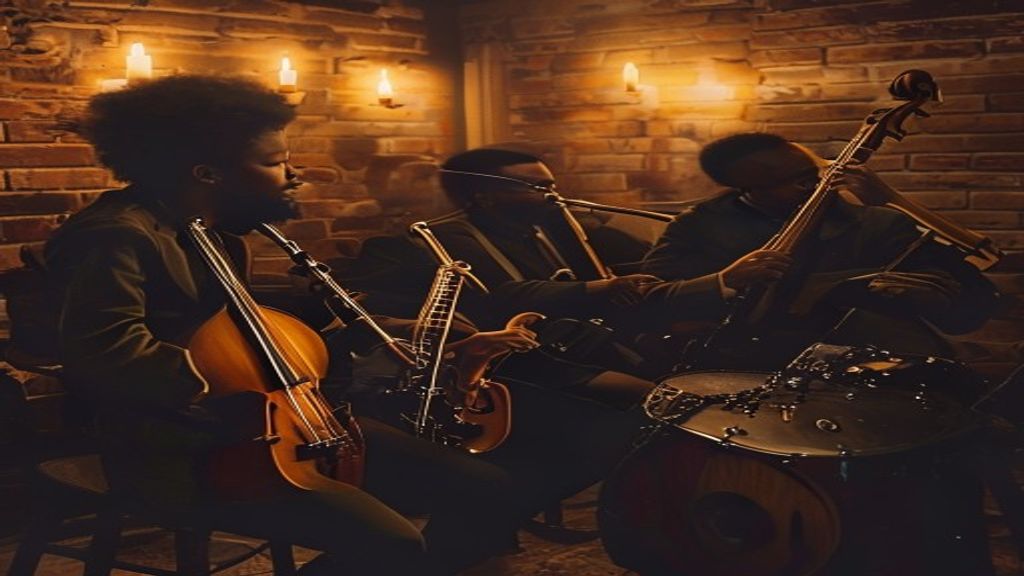
A jazz ensemble: four musicians who have played together long enough that something takes over. The bassist feels the drummer lean into a new rhythm before the sticks change pattern. The pianist hears a harmonic space opening and fills it with a chord no one expected but everyone needed. The saxophone player closes their eyes and rides the wave. Afterward, asked who decided to change key in the bridge, each musician points to someone else. No one decided. The field decided. The musicians were its instruments.
Where You Can See It
Mbuti forest camps, Ituri Forest, Congo. Small bands of twenty to thirty people who make every decision through collective sensing. No chiefs. No councils. The group reads the forest and reads each other simultaneously — when to move camp, where to hunt, how to distribute food. Anthropologists describe a "group mind" that operates through gesture, breath, and proximity rather than speech. Decisions emerge from shared attention the way weather emerges from the interaction of pressure systems.
A Quaker meeting for business. Not worship — governance. The clerk poses a question and the room enters silence. When someone is moved to speak, they stand. The clerk listens for the "sense of the meeting" — not majority opinion, not consensus, but the felt direction of the field. Sometimes the clerk says, "I sense we are not yet clear," and the silence continues. Sometimes an hour passes with three sentences spoken, and everyone knows the decision. This is field sensing formalized into governance, practiced for four hundred years.
Any playground at recess. Watch thirty children for ten minutes. No one organizes them. No one assigns groups. Yet within moments, clusters form, games emerge, roles distribute, and the whole playground becomes a self-organizing system. Two children who have never met join the same chase game and know the rules without being told. A conflict arises and resolves — often without words — and play continues. This is field sensing before adults teach children to override it with rules.
What We're Building
A community that trusts the field more than it trusts any individual's plan. Practically, this means: a rotating field council with no agenda, meeting weekly to listen. Decision-making distributed to the edges — anyone can initiate, the field responds through participation or its absence. No votes unless the field is genuinely split, and even then, the vote is a last resort, an acknowledgment that the field's signal isn't clear yet.
Training happens not in workshops but in daily practice: shared silence at dawn where you feel the field before words arrive. Cooking together, where the rhythm of chopping and stirring teaches you to sense what the person beside you needs without asking. Building together, where you hand someone a tool before they reach for it. Over months, the boundary between "I notice" and "we notice" blurs. Over years, it dissolves.
The field council keeps a sensing journal — not minutes, but impressions. "The field felt heavy in the east quadrant this week." "There's a brightness around the children's garden." Reading back through the journal, patterns emerge that no individual noticed. The field is always speaking. The journal teaches the community to listen.
Resources
- Sociocracy For All — collective sensing and consent rounds (type: guide)
- The Work That Reconnects — practices for sensing the larger field (type: guide)
- 📖 Telepathic Communication — New Earth Vision — direct field sensing replacing language-mediated interaction (type: guide)
The Questions That Live Here
These are not questions to answer but questions to live inside:
- Can you feel the difference between your own thought and a thought the field is having through you?
- What does the field around you need right now — not the people, the field itself?
- Is there a minimum group size where field sensing becomes reliable? (We think 8-12, the same as a fire circle.)
- How do you strengthen field sensing without turning it into a technique?
Influences and connections
Listening for voices…
Connected Frequencies
The people, places, works, and concepts the graph shows connected to this one.